

A recurring fee reduces capital available to compound in later periods. The total effect depends on the amount charged, when it is charged and the return path. Compare complete costs in money and percentage terms, including costs that do not appear as a management fee.
The financial mechanism
An investment may involve platform charges, fund expenses, advice fees, spreads, commissions and financing. Some are explicit deductions; others are embedded in execution prices. A low stated commission therefore does not establish a low total cost. Trading frequently can turn a small per-trade expense into a material annual burden.
Distinguish avoidable implementation cost from the price of a useful service. The question is whether the service provides enough value for your circumstances after all charges, not whether every fee is undesirable. Compare like-for-like risk and liquidity rather than assuming a cheaper but very different exposure is equivalent.
A worked example
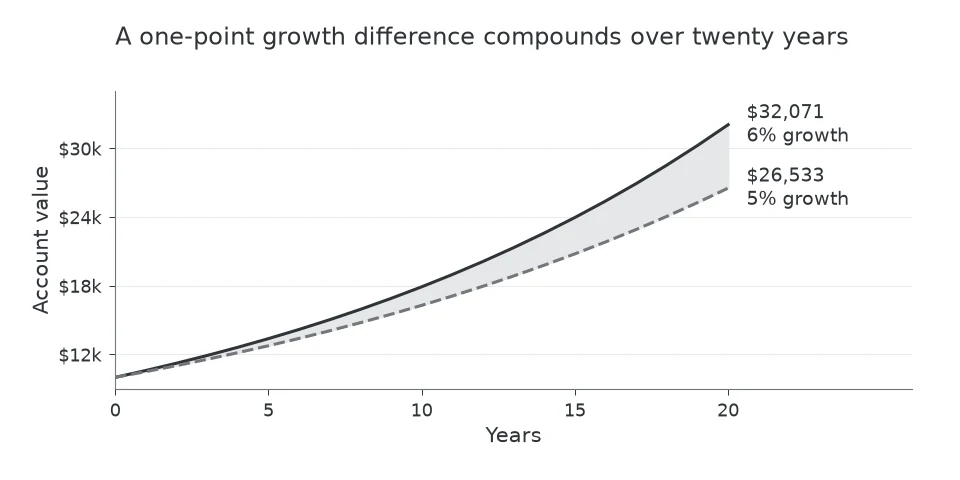
As a simplified illustration, $10,000 compounding at 6% for twenty years reaches about $32,071. At 5% it reaches about $26,533. The approximately $5,538 difference is larger than twenty flat charges of $100 because less capital remains invested each year. This is a comparison of assumed constant net growth rates, not an exact model of every fee contract or a promise of a 6% gross return.
Practical review and implementation
Request a cost schedule and translate each item into an annual money estimate using realistic turnover and holding periods. Test a quiet period and a stressed period with wider spreads or higher financing. Record whether reported performance is gross or net, and whether any tax or advisory charge is excluded. When reviewing a trading system, reconcile the net ledger rather than subtracting an estimated commission a second time from already net figures.
Assumptions and limitations
Actual charges can be tiered, performance-linked or deducted at different times, so the illustration is deliberately simplified. Taxes are personal and jurisdiction-specific. A higher-cost approach can outperform a lower-cost one, but it must first overcome its additional costs; past outperformance does not establish that it will do so again.
Primary references
Further detail on the underlying concepts and data definitions: