

Purge training observations when their outcome intervals overlap the validation interval and would reveal information used to score that validation set. The relevant object is the label's start-to-end interval, not only the feature timestamp. A fixed time gap is a useful special case, but variable holding periods require interval-aware checks.
The statistical issue
A five-day forward return measured on adjacent days shares most of its underlying price changes. If those labels are distributed across training and validation folds, the model can learn from outcomes that partly contain the validation period. A random row split therefore exaggerates the independence of the evaluation.
Purging removes overlapping training labels. An embargo excludes additional observations near a boundary where information dependencies justify that exclusion. Their widths should follow the actual target and information process rather than a percentage selected because it improves the score.
A worked example
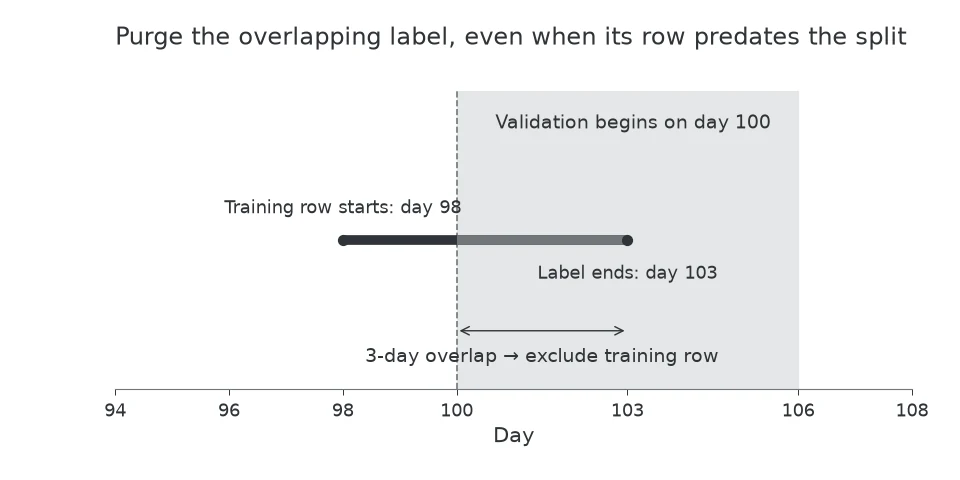
Consider a training row timestamped day 98 whose label ends on day 103. A validation interval begins on day 100. That training row overlaps three days of the validation interval even though its feature timestamp is earlier. Removing only rows dated day 100 or later leaves the leakage intact.
For a fixed five-session outcome and a strictly forward split, a correctly implemented gap can remove the affected boundary rows. For stop-based labels that end after one to twenty sessions, the required exclusion differs by observation. Store each label end time and test actual interval intersections instead of assuming five rows always means five sessions.
Practical review and implementation
Create explicit feature-availability, event-start and label-end timestamps. Build folds from the proposed evaluation timeline, then exclude training labels that intersect validation outcomes. Fit preprocessing and feature selection again after each exclusion. Use calendar-aware timestamps when assets have different sessions or irregular events.
Unit-check a small timeline by hand: list every retained training interval and confirm that it cannot expose a validation outcome. Compare the number of independent events with the raw row count. Keep any further gap policy fixed while evaluating candidate models.
Assumptions and limitations
Purging protects a particular information boundary. It does not remove every source of dependence, guarantee stationarity or stop a researcher repeatedly tuning to the same validation folds. Excessive exclusions can leave too little training data. If a dataset cannot support evaluation after its actual label overlaps are respected, that shortage is a research finding rather than a reason to ignore the overlap.
Primary references
Further detail on the underlying concepts and data definitions: