

Volatility targeting scales exposure in response to an estimate of variability. A simple rule multiplies a base position by target volatility divided by estimated volatility, subject to caps. It aims to stabilise a measure of risk, not to keep losses within a fixed boundary.
The portfolio mechanism
The estimate introduces a trade-off. A short window responds quickly but is noisy; a long window is smoother but can react slowly after a regime change. Exposure can rise after a calm period and shrink after a volatile decline. This behaviour is systematic, but it can still be economically uncomfortable or procyclical.
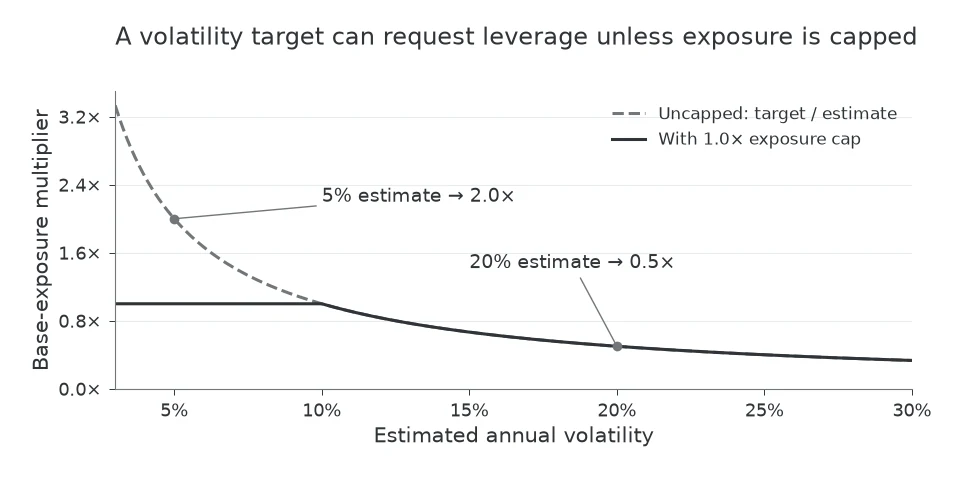
The complete rule needs a volatility floor, leverage ceiling, resizing schedule and transaction-cost model. Without a floor, a near-zero estimate can request an implausibly large position. Without a liquidity constraint, the desired reduction may be hardest to execute when it is most needed.
A worked example
Take a 10% volatility target and a 20% estimated annual volatility. The simple multiplier is 0.5. If the estimate later falls to 5%, it requests a multiplier of 2.0. The second case doubles base exposure and may require borrowing or derivatives. A leverage cap of 1.0 would deliberately prevent the rule from reaching its nominal target in that environment.
Practical review and implementation
Evaluate the complete capped process using lagged estimates and realistic rebalance timing. Stress a sudden price gap before the estimator updates. Compare turnover, drawdown, financing and capacity with the unscaled strategy, rather than checking volatility alone. Keep scaling separate from signal conviction so a lower estimate is not mistaken for stronger evidence that the strategy is correct.
Assumptions and limitations
Realised future volatility need not match the estimate, and jump losses can exceed the apparent target dramatically. Correlations and funding requirements can change at the same time. A volatility target is a model parameter, not a maximum-loss promise or a reason to deploy leverage without a separate risk assessment.
Primary references
Further detail on the underlying concepts and data definitions: